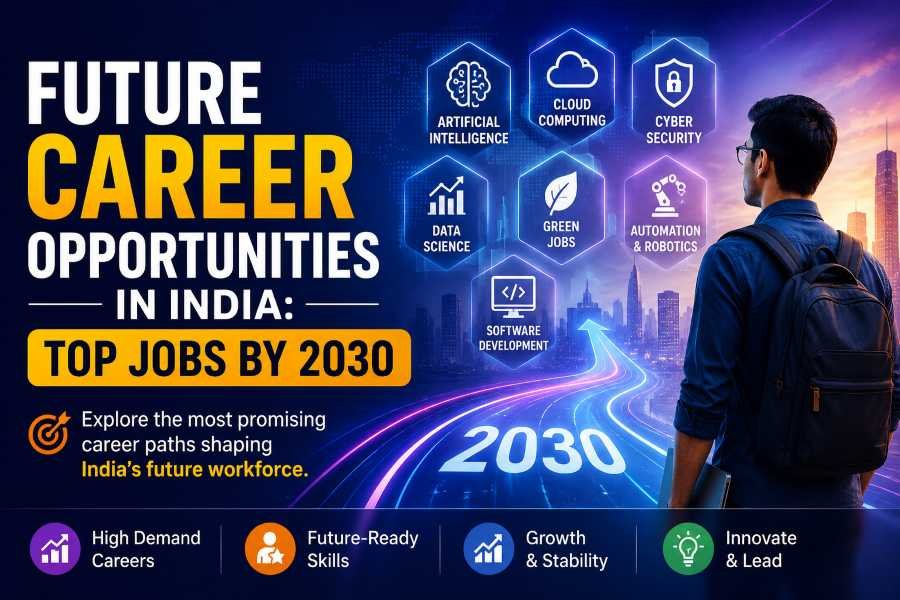
Future Career Opportunities in India Top Jobs by 2030
What will your job look like five years from now? For a growing number of professionals, the honest answer is: probably not what it looks like today. The World Economic Forum's Future of Jobs Report 2025 projects that 22% of current jobs globally will be structurally disrupted by 2030, with 170 million new roles created and 92 million displaced — a net gain of roughly 78 million jobs worldwide, but a genuinely different mix of what those jobs actually are. India, with its scale, young workforce, and fast-expanding digital and green economies, sits right at the center of this shift.
This isn't about which job is hiring this month — it's about where real, structural opportunity is building over the next several years, and what skills will matter most once it arrives.

The Big Picture: What the World Economic Forum Says About 2030
Four forces are reshaping the global job market simultaneously: rapid technological change (AI, robotics, and digital access), demographic shifts (aging populations in some regions, growing working-age populations in others), economic pressures like inflation and slower growth, and geoeconomic fragmentation affecting trade and business models. The combined effect is significant: nearly 40% of workers' core skills are expected to change by 2030, and 86% of employers expect AI and information-processing technologies to transform their businesses within the same timeframe.
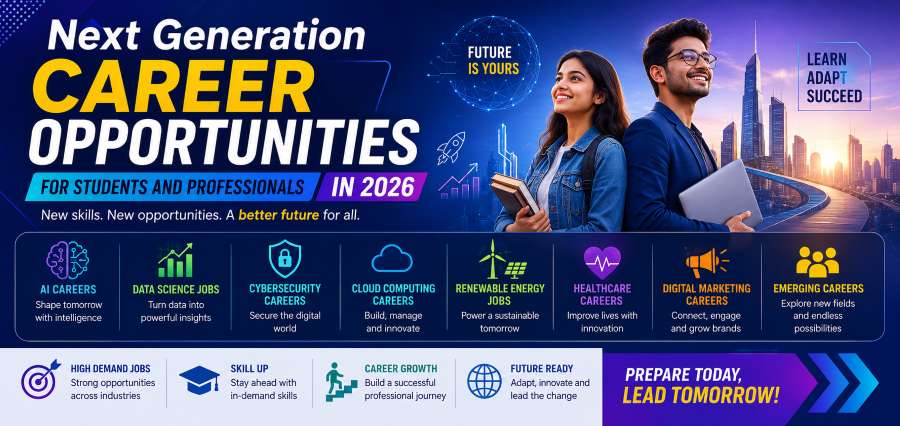
Future Career Opportunities in India: Where the Growth Is
1. Artificial Intelligence & Machine Learning
India currently has an estimated 420,000 AI/ML practitioners against a projected demand of 1.2 million by 2030 — representing the single largest talent shortage in the country's economy. This gap alone makes AI/ML one of the most durable career bets available to Indian professionals over the next several years.
2. Green Energy & Sustainability
India's green economy is projected to reach roughly USD 1 trillion by 2030, with the country on track to create 7.29 million green jobs by FY28 and up to 35 million by 2047. Beyond familiar solar and wind roles, the National Green Hydrogen Mission is opening genuinely new engineering paths — designing electrolyzers, optimizing EV battery storage, and managing smart grids — that go well beyond "climbing wind turbines" and into serious chemical and mechanical engineering territory.
3. Electric Vehicles & Battery Technology
India's EV ecosystem could generate up to 10 million jobs by 2035, according to NITI Aayog and the Rocky Mountain Institute, driven by rising EV adoption, a projected need for at least 20 battery gigafactories by 2030, and the buildout of nearly 3 million charging stations — creating demand well beyond engineers, into electricians, technicians, and service roles.
4. Space Economy
Since India opened its space sector to private companies in 2023, startups like Agnikul Cosmos and Skyroot Aerospace have been actively building and launching rockets, creating real technical and engineering career paths beyond government space agencies like ISRO for the first time in the country's history.
5. Semiconductors & Electronics
India is already a global leader in chip design, home to roughly 20% of the world's chip designers, and continued investment in domestic semiconductor manufacturing is expected to expand demand for electronics and hardware engineering talent significantly through 2030.
6. Healthcare
India's healthcare industry is projected to become an USD 800 billion market by 2030, increasingly driven by growth in Tier 2 and Tier 3 cities. An aging population and expanding healthcare access make this one of the most consistently resilient future career categories, spanning clinical roles, health-tech, and care work.
7. Cybersecurity
As digital access expands and geoeconomic tensions rise, information security analysts and cybersecurity specialists are seeing structural demand growth across nearly every industry, not just technology companies.
8. Frontline and Care Roles
Here's a genuine surprise in the WEF data: frontline roles like farmworkers, delivery drivers, and construction workers are projected to see the largest job growth by absolute numbers globally, alongside significant increases in care roles like nursing. Not every future career opportunity requires a technical degree — the green transition and demographic shifts are creating substantial demand in these categories too.
Skills That Will Matter Most by 2030
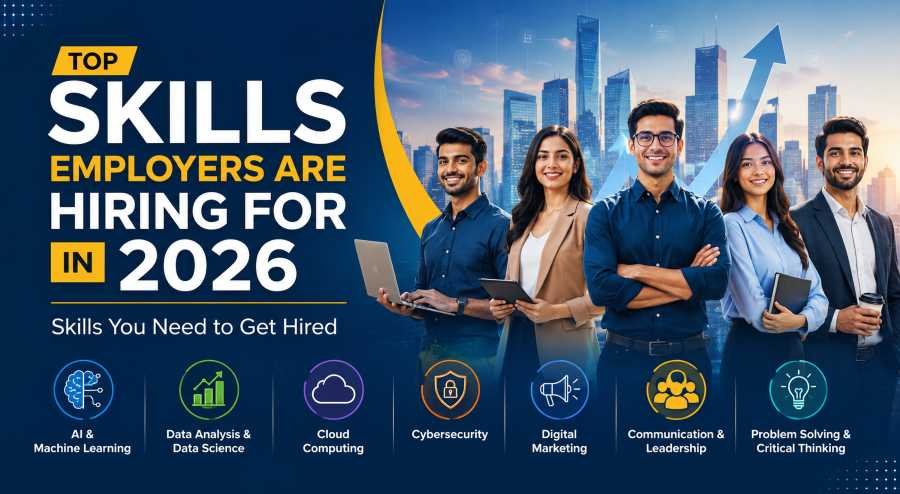
Technical skills like AI and big data literacy, cybersecurity, and networks are projected to grow rapidly in importance, but they're only half the picture. The WEF places equal weight on human skills: critical thinking, creative thinking, resilience, and collaboration are expected to define employability just as much as technical fluency. As one India Skills Report director put it, the real advantage increasingly belongs to hybrid professionals — a doctor who understands health tech, or an accountant fluent in AI tools — over narrow specialists in either domain alone.

Jobs at Risk: What's Fading
- Repetitive data-entry and purely administrative roles face the highest automation risk over the next several years.
- Manual dexterity and precision-based tasks are projected to decline in relative importance as automation expands.
- This rarely means an entire job title disappears overnight — more often, the specific tasks within a role shift substantially, requiring the person in that role to adapt.
How to Future-Proof Your Own Career
Upskilling has emerged as the top workforce strategy for 85% of employers globally, ahead of both automation and external hiring — a clear signal that continuous learning, not job-hopping alone, is what employers themselves are betting on. For individual professionals, the most resilient approach combines a genuine domain specialization with real digital fluency, treats reskilling as an ongoing habit rather than a one-time course, and stays deliberately alert to which tasks within your own role are shifting, rather than waiting for an entire job title to become obsolete before adapting.
- Pair your existing domain expertise with one genuinely useful digital skill, rather than starting from scratch in an unrelated field.
- Treat reskilling as a continuous habit — short courses and certifications every year — rather than a one-time credential.
- Pay attention to which specific tasks in your current role are being automated, and proactively build skills in the tasks that are growing instead.
- Stay open to emerging sectors like green hydrogen, space technology, or semiconductors, even if they feel unfamiliar today, since early movers in genuinely new fields often face far less competition.
Where in India These Opportunities Are Concentrated
Future career growth isn't evenly spread across the country. Hyderabad has emerged as a strong hub for AI, data science, pharma, and biotech roles. Delhi NCR leads in fintech, government technology, logistics, and defence-related careers. Chennai is growing quickly in EV engineering, IT services, and healthcare, while renewable energy job clusters are concentrated heavily in Rajasthan, Gujarat, and Tamil Nadu, spanning everything from panel assembly to grid integration. Understanding where a given sector is actually clustering can meaningfully shape both where you look for opportunities and whether relocation might be worth considering for a specific career path.
Conclusion
The future of work isn't a distant, abstract concept — it's already reshaping India's job market in AI, green energy, electric vehicles, space technology, semiconductors, healthcare, and even frontline and care work. The professionals who come out ahead over the next several years won't necessarily be the ones who guessed the single "right" industry, but the ones who built genuine adaptability: real domain expertise, digital fluency, and a habit of continuous learning that lets them move with the shift rather than being caught off guard by it.
Frequently Asked Questions (FAQs)
Q1. What does the World Economic Forum predict about jobs by 2030?
The WEF's Future of Jobs Report 2025 projects that 22% of current jobs globally will be structurally disrupted by 2030, with 170 million new roles created and 92 million displaced, for a net gain of roughly 78 million jobs. It also estimates that nearly 40% of workers' core skills will change during this period.
Q2. Are future career opportunities in India only in technology?
No. While AI, semiconductors, and green energy are major growth areas, the WEF report specifically highlights frontline and care roles — including farmworkers, delivery workers, construction workers, and nursing professionals — as seeing some of the largest job growth by absolute numbers, alongside skilled trades and healthcare.
Q3. How big is India's green jobs opportunity?
Substantial. India's green economy is projected to reach roughly USD 1 trillion by 2030, with an estimated 7.29 million green jobs created by FY28 and up to 35 million by 2047, spanning renewable energy, electric vehicles, green hydrogen, and sustainable infrastructure.
Q4. What skills should I build now to future-proof my career?
The WEF identifies critical thinking, creative thinking, resilience, and lifelong learning as core future skills, alongside technical literacy in areas like AI and big data. Combining a strong domain specialization with genuine digital fluency — rather than choosing one over the other — tends to offer the strongest long-term career protection.
Q5. Which jobs are most at risk of disappearing by 2030?
Roles centered on repetitive, administrative, and data-entry tasks face the highest disruption risk, since these are most easily automated. This doesn't necessarily mean entire job titles vanish overnight, but the specific tasks within many roles will shift substantially, making continuous reskilling important even within established careers.
Q6. Is India's space sector really a viable career option now?
Yes, increasingly so. India opened its space sector to private companies in 2023, and startups like Agnikul Cosmos and Skyroot Aerospace are actively building and launching rockets, creating real engineering and technical opportunities well beyond government space agencies alone.
Thank you for reading 🙂
Campaigns & Elections
------------------------------------------------------------------------------------------------------------------------------------------------
Career Resources & Planning
Read more blogs: click here
Follow on Instagram
Jobs
Resumes & Portfolios
If you want to build your website at an affordable price, contact https://www.nextrtechnology.com/