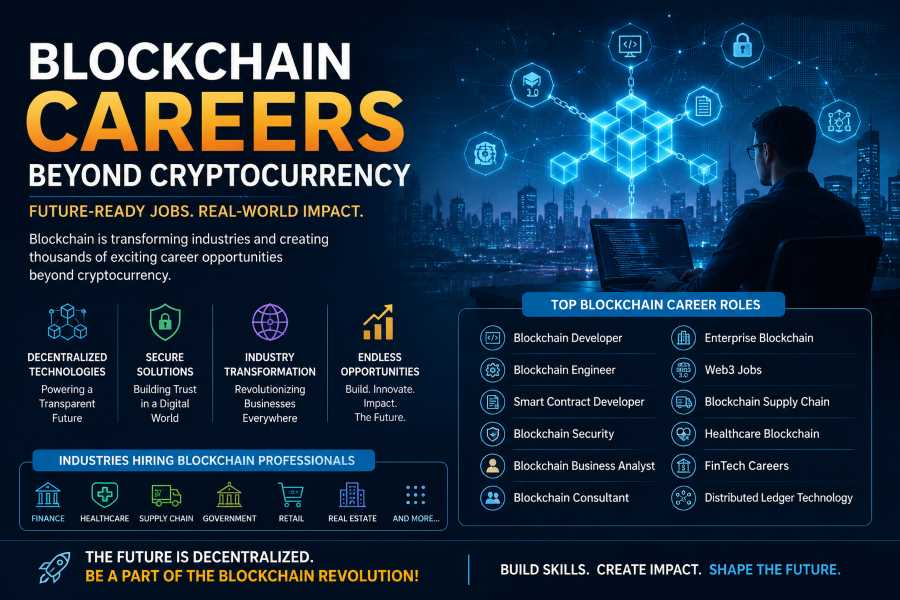
Blockchain Careers Beyond Cryptocurrency Jobs in 2026
Blockchain technology is not about Bitcoin and other cryptocurrencies anymore. These days, businesses, governments, healthcare providers, logistics companies and financial institutions are using blockchain to make things more transparent, secure and efficient. As more companies adopt blockchain, people with blockchain skills are becoming increasingly sought after across industries.

In 2026, blockchain is going to be one of the fastest-growing technology sectors, creating thousands of new job opportunities that have nothing to do with digital currencies. Whether you are a software developer, cybersecurity specialist, project manager or business analyst, blockchain has some exciting career paths with good salaries and long-term growth.
Why Blockchain Skills Are in Demand
Companies are using blockchain because it provides:
* Secure and tamper-proof transactions
* data management
* Improved transparency
* Reduced operational costs
* Enhanced supply chain visibility
* Faster cross-border payments
* Strong digital identity verification
As businesses start using enterprise blockchain platforms, the demand for professionals is increasing.
Industries Hiring Blockchain Professionals
Blockchain is changing industries beyond cryptocurrency.
1. Banking and Financial Services
Banks use blockchain for payments, fraud prevention, smart contracts, international money transfers and customer identity verification. Financial institutions are investing heavily in blockchain-powered solutions.
2. Supply Chain and Logistics
Supply chain companies use blockchain to track goods from manufacturers to consumers. The benefits include real-time shipment tracking, product authenticity verification, reduced fraud, better inventory management and faster documentation. Global logistics companies are hiring blockchain specialists to improve efficiency.
3. Healthcare
Healthcare organisations use blockchain to secure records and improve medical data sharing. Blockchain is used for health records, drug traceability, clinical research, insurance claims and medical supply chain monitoring. Healthcare blockchain careers are going to grow over the coming years.
4. Government and Public Services
Governments are exploring blockchain for identity management, land registry systems, voting platforms, tax administration and public record management. These initiatives create opportunities for blockchain consultants and security experts.
5. Retail and E-commerce
Retail businesses use blockchain for product authentication, customer loyalty programs, supply chain transparency, digital payments and warranty verification. Luxury brands and online marketplaces are relying more on blockchain technology.
Top Blockchain Careers Beyond Cryptocurrency
1. Blockchain Developer
Blockchain developers build applications, smart contracts and enterprise blockchain systems. They write blockchain code, develop contracts, maintain blockchain infrastructure and create decentralised applications. Blockchain developers need to know Solidity, JavaScript, Python, Ethereum, Hyperledger and Node.js.
2. Blockchain Solution Architect
Solution architects design blockchain systems for businesses. They do system architecture, technology selection, security planning, business integration and performance optimization. This role combines expertise with strategic planning.
3. Smart Contract Developer
Smart contract developers create automated agreements that execute without intermediaries. They work on banking, insurance, real estate, gaming and healthcare projects. Knowledge of Solidity and Ethereum is essential for this career.
4. Blockchain Security Specialist
Security professionals protect blockchain platforms against cyber threats. They do contract auditing, vulnerability assessment, security testing, risk analysis and incident response. Cybersecurity combined with blockchain knowledge is highly valuable.
5. Blockchain Business Analyst
Business analysts help organisations identify blockchain opportunities. They gather requirements, do process analysis, communicate with clients, document projects and develop business strategies. This role is ideal for professionals with business and technology backgrounds.
6. Blockchain Project Manager
Project managers oversee blockchain implementation from planning to deployment. They manage budgets, coordinate teams, manage risks, plan timelines and communicate with clients. Strong leadership and Agile experience are advantageous.
7. Blockchain Consultant
Consultants advise businesses on blockchain adoption strategies. They help organisations evaluate blockchain solutions, improve efficiency, select suitable platforms, develop implementation roadmaps and ensure regulatory compliance.
Essential Skills for Blockchain Careers
To succeed in blockchain-related roles, professionals should develop skills like blockchain fundamentals, smart contracts, distributed ledger technology, cryptography, cloud computing and programming languages. They should also have skills like problem-solving, communication, team collaboration, critical thinking, project management and analytical reasoning.
Popular Blockchain Platforms
Professionals should become familiar with leading blockchain platforms like Ethereum, Hyperledger Fabric, Polygon, Solana, Avalanche, Corda, IBM Blockchain and Binance Smart Chain. Enterprise blockchain platforms are particularly valuable for careers.

Certifications That Can Boost Your Career
Certifications include Certified Blockchain Professional, Certified Blockchain Expert, Hyperledger Certification, Ethereum Developer Certification and IBM Blockchain Foundation Certification. Certifications validate your expertise. Improve employability.
Future of Blockchain Careers
By 2026 and beyond, blockchain will continue expanding into industries like intelligence, Internet of Things, digital identity, decentralized finance and smart cities. Organisations will seek professionals who can integrate blockchain with cloud computing, cybersecurity and data analytics. As regulations mature and enterprise adoption accelerates, blockchain careers will become more diverse, offering opportunities for both non-technical professionals.
Conclusion
Blockchain technology has moved beyond cryptocurrency and is now driving innovation across finance, healthcare, logistics, retail, government and many other sectors. This shift has created a range of rewarding career opportunities from blockchain developers and security specialists to consultants and project managers. Developing blockchain skills can open doors to paying future-ready roles.
Frequently Asked Questions (FAQs)
1. Can I build a blockchain career without working in cryptocurrency?
Yes, many organisations use blockchain for supply chain management, healthcare, finance, digital identity and enterprise applications without involving cryptocurrencies.
2. Which industries offer the most blockchain job opportunities?
Banking, healthcare, logistics, retail, insurance, government, manufacturing and enterprise software are among the industries hiring blockchain professionals.
3. What programming languages are important for blockchain careers?
Popular languages include Solidity, Python, JavaScript, Go, Rust, C++ and Java, depending on the blockchain platform and role.
4. Is blockchain a career choice in 2026?
Yes, enterprise blockchain adoption continues to grow making it a promising career with demand, competitive salaries and opportunities across multiple sectors.
5. Do I need a computer science degree to work in blockchain?
Not necessarily, while a technical background is beneficial, for development roles, business analysts, consultants, project managers and compliance specialists can enter the field through certifications, practical experience and relevant domain knowledge.
Thank you for reading 🙂
------------------------------------------------------------------------------------------------------------------
Read more blog click here
Follow us on Instagram
If you want to build your website at an affordable price, then click here