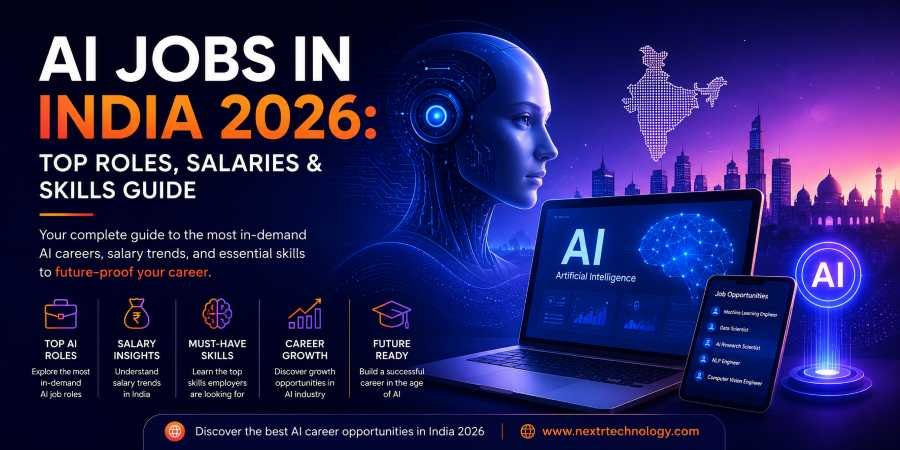
AI Jobs in India 2026 Top Roles Salaries and Skills Guide
India's AI job market isn't a future prediction anymore — it's happening right now, and at a pace few other tech sectors have ever matched. The country's AI market, valued at roughly USD 9.51 billion in 2024, is forecast to grow past USD 130 billion by 2032, and AI-related hiring is projected to grow around 32% in 2026 alone. More striking still: while India is expected to need well over a million skilled AI professionals in the next couple of years, current trained talent covers only a fraction of that demand. For job seekers willing to build the right skills, that gap represents one of the strongest windows of opportunity in the Indian job market today.
Here's a practical breakdown of the AI jobs actually hiring in India right now, what they pay, and how to realistically position yourself for one.

Why AI Jobs Are the Biggest Opportunity in India's Job Market
The core driver behind AI hiring in 2026 is simple: demand has outpaced supply by a wide margin. Industry estimates suggest fewer than 20% of India's AI talent need is currently being met by trained professionals, even as around 11.7% of all job postings in India now explicitly require AI skills, up sharply from previous years. Every major bank, hospital network, e-commerce company, and IT services firm is deploying AI systems, and they're competing hard for a limited pool of qualified candidates — which is exactly why salaries in this space have climbed so quickly.
Top AI Job Roles in India for 2026
1. Machine Learning Engineer — approx. ₹6-35 LPA
The highest hiring-volume role in India's AI ecosystem. ML engineers build and deploy models that power everything from recommendation systems to fraud detection. Core requirements include Python, ML algorithms, SQL, and cloud deployment experience.
2. Generative AI / LLM Engineer — approx. ₹7-38 LPA
The fastest-growing AI role in the country. GenAI engineers build applications on top of large language models — chatbots, internal assistants, document-processing tools, and retrieval-augmented generation (RAG) systems. This is where salary growth is currently most aggressive.
3. Data Scientist — approx. ₹5-30 LPA
Data scientists turn raw business data into actionable insight, working across analytics, statistical modeling, and increasingly, applied AI. This remains one of the most broadly hired AI-adjacent roles across industries.
4. NLP Engineer — approx. ₹7-38 LPA
Natural Language Processing engineers build systems that understand and generate human language — chatbots, sentiment analysis tools, and document processing systems — and are in strong demand as GenAI applications scale.
5. Computer Vision Engineer — approx. ₹6-32 LPA
A particularly strong role in India due to demand from manufacturing, healthcare imaging, security, and AR/VR. Computer vision engineers work on image and video analysis systems.
6. MLOps Engineer — approx. ₹8-35 LPA
MLOps engineers handle the deployment, monitoring, and scaling of machine learning models in production. This role currently offers one of the best fresher salary-to-competition ratios in the AI space, since it's less saturated than pure ML roles.
7. Prompt Engineer — approx. ₹6-22 LPA (up to ₹40-60 LPA for senior roles)
Prompt engineering has evolved from a novelty role into a genuine specialization, particularly when combined with Python and RAG skills. Pure prompting skills alone tend to cap lower; combining them with coding ability significantly raises the ceiling.
8. AI Product Manager — approx. ₹12-45 LPA
This role sits between business and technology, deciding what AI features to build, why they matter, and how success is measured. Demand is rising quickly as AI capabilities become core to more products.
9. AI Ethicist / Responsible AI Specialist — emerging, competitive pay
An emerging but fast-growing role, particularly in banks, large IT firms, and global service companies. These specialists check AI systems for bias, data privacy compliance, and adherence to evolving global AI regulations.
10. AI Research Scientist — approx. ₹18-40 LPA
A more specialized, research-driven role focused on advancing model architectures and techniques, typically requiring deeper theoretical expertise and often an advanced degree, though strong practical research portfolios can also open doors.
Skills That Actually Get You Hired in 2026
- Python — the foundational language across nearly every AI role.
- PyTorch or TensorFlow — core frameworks for building and training models.
- SQL and data handling — essential for working with real-world datasets.
- Cloud AI platforms (AWS SageMaker, Google Vertex AI, Azure ML) — can boost salary offers by 30-40% on their own.
- Generative AI tools and frameworks (LLMs, LangChain, RAG systems) — the single fastest-growing specialization area.
- Domain expertise in a specific industry (healthcare, finance, logistics) combined with AI skills — often more valuable to employers than AI knowledge alone.
What Freshers Need to Know
If you're entering the job market without corporate experience, two things matter more than your degree: the specific role you target, and the proof you can show for it. Around 73% of Indian employers planned to hire freshers in the first half of 2026, and they're screening heavily for real projects and portfolios rather than certificates alone. Fresher hiring in AI/ML has grown by more than 20% year-on-year, and candidates with a strong project portfolio in Python and PyTorch are increasingly able to negotiate ₹10-18 LPA offers at product companies, even without prior work experience. For non-coding backgrounds, roles like Data Analyst with AI skills tend to offer the most accessible entry point into the field.
Which Indian Cities Pay the Most for AI Talent
Bengaluru remains India's clear AI salary leader, commanding a premium of roughly 20-30% over other cities, thanks to its concentration of product companies, startups, and global tech offices. Hyderabad, Pune, and Gurgaon follow as the next strongest markets, each home to a growing base of GCCs and product engineering teams. Remote roles with global companies can offer compensation that exceeds even Bengaluru's premium, for candidates with the right specialized skill set.
A Practical Roadmap to Break Into AI
- Build core fundamentals first: Python, statistics, and basic machine learning algorithms.
- Pick one specialization to go deep on — Generative AI, computer vision, or MLOps — rather than spreading thin across everything.
- Build 2-3 real, deployable projects you can discuss in detail during interviews, not just tutorial completions.
- Add cloud platform experience, since it's one of the highest-leverage additions to any AI resume.
- If you're starting at a services company like TCS or Infosys, plan your move to a product company or GCC after 2-3 years, since that switch commonly triggers a 50-70% salary jump.
Is the AI Job Boom Sustainable?
Worth being honest about: the scarcity-driven salary premium currently seen in roles like Generative AI engineering is unlikely to last indefinitely. As more engineers upskill into GenAI-shaped roles — with some estimates suggesting four out of five engineers will need to upskill by 2027 to stay relevant — today's outsized salary gaps will likely narrow over time. That doesn't mean AI careers are a passing trend; it means the strongest financial upside belongs to professionals who build real skills now, while the demand-supply gap remains this wide.

Conclusion
AI careers in India have moved from a niche specialization to one of the most reliable paths to strong, fast-growing compensation in the country's job market. Whether you're a fresher building your first portfolio or an experienced professional considering a pivot, the roles, skills, and roadmap covered here reflect where real hiring demand exists right now — not just where the hype is loudest. The opportunity is genuine, but it rewards people who commit to building demonstrable, real-world skills over those simply chasing a trending job title.
Frequently Asked Questions (FAQs)
Q1. Do I need a computer science degree to get an AI job in India?
No. While a CS or engineering background helps, many AI roles are open to candidates from math, statistics, economics, and even MBA backgrounds who build the right skills through certifications and real portfolio projects. Hiring in 2026 is largely skills-first, with recruiters screening for demonstrable ability and project experience over degree alone.
Q2. What is the average salary for an AI fresher in India in 2026?
Most AI and ML freshers in India earn between roughly ₹5-15 LPA depending on skills, project experience, and location, with strong candidates who have a solid portfolio and skills like Python and PyTorch able to negotiate ₹10-18 LPA at product companies.
Q3. Which AI role pays the most in India?
Generative AI and LLM engineering roles currently offer some of the highest salary ceilings, with experienced professionals earning anywhere from roughly ₹20 LPA to ₹70+ LPA depending on company and specialization. AI Product Manager and AI Research Scientist roles also command strong senior-level compensation.
Q4. Which Indian city offers the best AI salaries?
Bengaluru consistently offers the highest AI salaries in India, commanding a premium of roughly 20-30% over other cities, followed by Hyderabad, Pune, and Gurgaon. Remote roles with global companies can offer even higher compensation for the right skill set.
Q5. What skills should I learn first to break into AI?
Start with Python, core machine learning algorithms, and SQL, then build toward a framework like PyTorch or TensorFlow. From there, specializing in a high-demand area such as Generative AI, MLOps, or computer vision, combined with cloud platform experience (AWS SageMaker, Google Vertex AI, or Azure ML), significantly strengthens your profile.
Q6. Is now a good time to switch careers into AI?
Many industry reports point to a real supply-demand gap in India's AI talent market, with training output currently well below the number of AI professionals companies need. That gap is creating strong hiring demand and competitive salaries in 2026, though experts note this scarcity-driven premium is unlikely to last indefinitely as more professionals build these skills.
Thank you for reading 🙂
Campaigns & Elections
------------------------------------------------------------------------------------------------------------------------------------------------
Career Resources & Planning
Read more blogs: click here
Follow on Instagram
Jobs
Resumes & Portfolios
If you want to build your website at an affordable price, contact https://www.nextrtechnology.com/