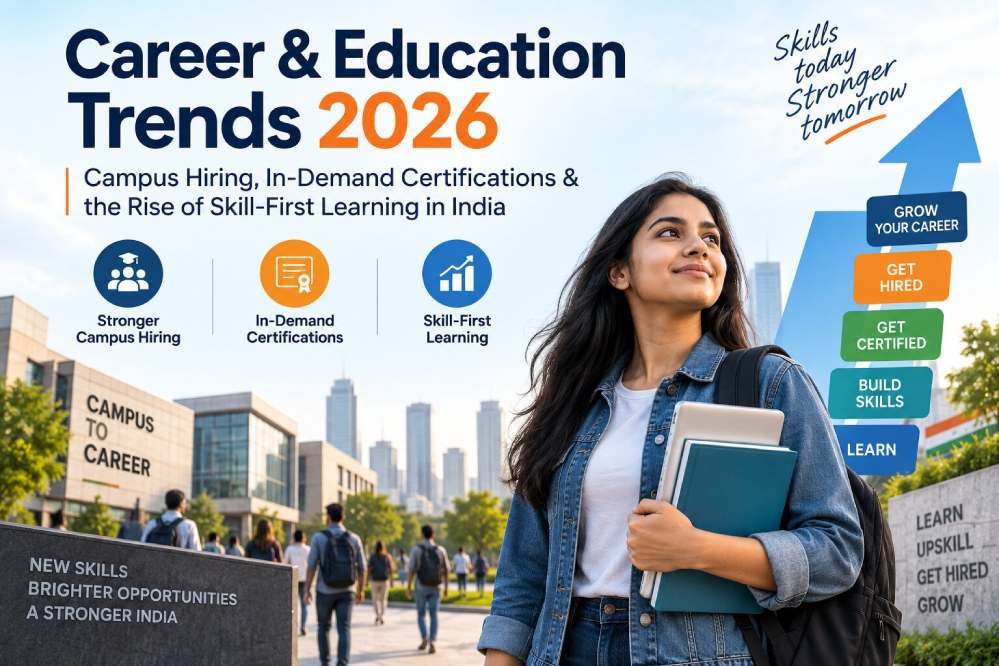
Career & Education Trends: Campus Hiring, In-Demand Certifications & the Rise of Skill-First Learning in India
For students and job seekers in India, 2026 is turning out to be a year where career planning and education choices are more closely linked than ever. Employers are hiring freshers with real intent, but they're also getting far more specific about what skills, certifications, and learning pathways they expect candidates to bring to the table.
At the same time, India's education and ed-tech landscape is evolving quickly, from degree apprenticeships to AI-powered learning platforms, giving students more ways than ever to build job-ready skills alongside, or even instead of, a traditional degree.
If you're a student, recent graduate, or working professional trying to plan your next move, here's a complete look at the career and education trends shaping India in 2026, and how to use them to your advantage.
The latest campus hiring data, in-demand courses, and education trends shaping careers in India this year
1. Campus & Fresher Hiring Is Bouncing Back Strongly
One of the clearest positive signals this year comes from fresher hiring data. According to a recent industry career outlook report covering January to June 2026, 73% of employers surveyed across India said they intend to hire freshers this half-year, a sign of cautious but genuine confidence in entry-level talent. Sector-wise, demand is being led by retail, followed closely by e-commerce and technology start-ups, and manufacturing, all reporting hiring intent well above 80%.
Campus recruitment at tier-2 and tier-3 colleges has also seen a sharp rise, meaning fresher opportunities are no longer concentrated only around metro-city campuses. If you're studying outside a major city, this is genuinely good news: the hiring net is widening, not just moving to different companies, but to different regions altogether.
2. The Sectors Hiring Freshers the Most Right Now
India's job market is expected to grow at a healthy pace this year, with particularly strong momentum in IT, retail, telecommunications, and BFSI. Here's a closer look at where fresher demand is concentrated:
● Retail — roles like Dark Store Assistant and Inventory Management Assistant are seeing strong demand as quick-commerce and organised retail expand.
● E-commerce & Tech Start-ups — companies are hiring for roles such as Digital Sales Associate and Junior Web Developer.
● Manufacturing — demand is high for Inventory and Logistics Coordinator and Battery Assembly Technician roles, reflecting India's growing EV and electronics manufacturing push.
● IT & Software — still the single largest employer of freshers, with strong hiring for Software Developer, QA Analyst, and Cloud Support Associate roles, backed by structured programs like TCS NQT and Infosys InfyTQ.
● BFSI — banking, financial services, and insurance continue to offer stable entry-level roles in operations, risk, and customer service.
The common thread across all these sectors is clear: companies aren't just hiring for headcount; they're hiring for specific, demonstrable skills tied to real business needs.
3. The Certifications and Skills Employers Actually Want
If you're deciding what to study or which certification to pick up next, recent employer surveys offer a useful shortcut. The most in-demand courses freshers are being encouraged to pursue in 2026 include certifications in business analysis, AI and machine learning, cloud computing, AI-enabled digital marketing, and project management.
Just as important, though, are soft skills. Employers consistently rank communication, learning agility, problem framing, time management, and digital fluency among the top qualities they look for in fresher candidates, sometimes even ahead of technical knowledge. In a job market where technical tools change quickly, the ability to learn fast and communicate clearly is becoming a durable advantage that doesn't go out of date.
4. Degree Apprenticeships Are Becoming a Real Career Pathway
One of the more interesting shifts in Indian education this year is the growing employer interest in degree apprenticeship programs, which combine formal academic credit with structured, paid, on-the-job training. Rather than choosing between "get a degree" or "get work experience," students can now do both at the same time, graduating with both a qualification and genuine industry experience already on their resume.
For students weighing traditional degree programs against more work-integrated options, this is worth researching seriously. Employers increasingly value candidates who arrive with hands-on experience already validated by a company, not just classroom learning.
5. Online Learning & Edtech Are Reshaping How India Upskills
India's edtech sector has matured significantly, moving well beyond the video-lecture model of a few years ago. A few trends stand out in 2026:
● AI-powered learning assistants — personalised study plans, instant doubt-solving, and adaptive quizzes are now standard features on most major platforms.
● Hybrid learning models — many platforms now combine online modules with offline test centres or in-person mentorship, blending flexibility with accountability.
● Outcome-focused programs — career placement support, internship guarantees, and pay-after-placement models are becoming more common, shifting the value proposition from "content" to "career outcomes."
● NEP-aligned credit transfers — government platforms allow academic credits earned online to count toward a formal university degree, blurring the line between online learning and traditional higher education.
For working professionals in particular, this shift matters. Skill development is no longer just about collecting certificates; it's about staying visible, relevant, and promotable in a job market where roles and expectations keep shifting, often without a formal title change.

6. Government Skilling Initiatives Are Powering the Pipeline
Government-backed programs continue to play a meaningful role in India's talent pipeline. Initiatives like Skill India, Digital India, and Production Linked Incentive (PLI) schemes have accelerated the absorption of fresh talent into both traditional industries and new-age sectors like electronics manufacturing and clean energy.
For students, this means it's worth looking beyond private courses and exploring government-recognised skilling programs as well, many of which offer free or subsidised training directly aligned with sectors that are actively hiring.
7. How Students and Job Seekers Can Prepare
Given all these shifts, here's how to position yourself effectively in 2026:
● Pick certifications tied to active hiring demand — AI/ML, cloud computing, business analysis, and digital marketing are strong current bets.
● Don't neglect soft skills — practice communication and problem-framing as deliberately as you'd practice a technical skill.
● Look into degree apprenticeships or internship-linked programs if you want to graduate with real work experience already in hand.
● Use outcome-focused learning platforms that offer placement support, not just content, especially if you're upskilling to switch careers.
● Check eligibility for government skilling schemes before paying for private courses covering the same ground.
● Set up alerts on trusted job platforms like ClickNaukri so you can apply as soon as fresher openings in your target sector go live.
Conclusion
Career growth and education in India are converging more closely than ever in 2026. Fresher hiring is strong, especially in retail, e-commerce, manufacturing, IT, and BFSI, but employers are being far more deliberate about the specific skills, certifications, and soft skills they expect candidates to bring. At the same time, new pathways like degree apprenticeships and outcome-focused online learning are giving students more flexible, career-aligned ways to build those skills without waiting years for a traditional degree to catch up with industry needs.
The students and job seekers who will benefit most this year are the ones who treat learning as an ongoing part of their career strategy, not a one-time milestone. Keep building relevant skills, stay open to non-traditional learning pathways, and make sure you're checking the latest openings on ClickNaukri so you never miss the right opportunity at the right time.
Frequently Asked Questions (FAQs)
Q1. Is 2026 a good year for freshers to enter the Indian job market?
Yes. Recent industry surveys show 73% of employers plan to hire freshers in the first half of 2026, with especially strong demand in retail, e-commerce, technology start-ups, and manufacturing.
Q2. Which certifications are most valuable for freshers in 2026?
Certifications in business analysis, AI and machine learning, cloud computing, AI-enabled digital marketing, and project management are among the most in-demand right now, based on current employer hiring trends.
Q3. What is a degree apprenticeship, and is it worth considering?
A degree apprenticeship combines formal academic credit with structured, paid, on-the-job training, allowing students to graduate with both a qualification and real work experience. It's worth considering if you want practical experience alongside your degree rather than after it.
Q4. Do soft skills really matter as much as technical skills to employers?
Yes. Employers consistently rank communication, learning agility, problem framing, time management, and digital fluency among their top priorities for fresher candidates, often alongside or even ahead of specific technical skills.
Q5. Are online courses a good substitute for a traditional degree?
It depends on your goals. Many online platforms now offer NEP-aligned credit transfers that count toward a formal degree, plus outcome-focused programs with placement support, making them a strong complement to, or in some cases a genuine alternative to, parts of a traditional degree.
Q6. Where can I find the latest fresher and campus hiring opportunities?
You can explore regularly updated job listings across sectors and experience levels on ClickNaukri (www.clicknaukri.com), along with career advice to help you prepare for applications and interviews.
Published on ClickNaukri.com — India's trusted destination for the latest job openings, career advice, and hiring trends.
Thank you for reading
------------------------------------------------------------------------------------------------------------------------------------------------
Read more blogs: click here
Follow on Instagram