Skills vs Degree What Employers Value More in 2026
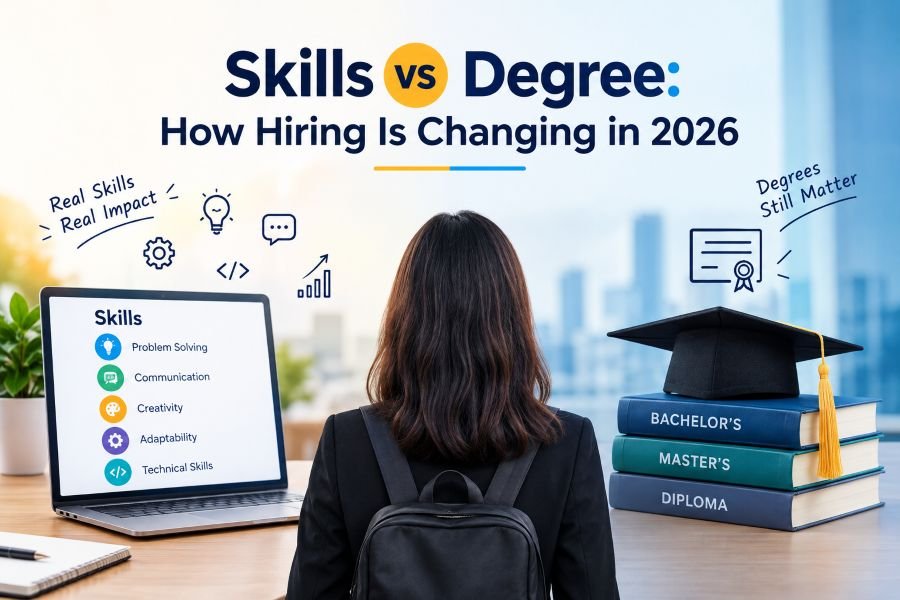
Skills vs Degree: How Hiring Is Changing in 2026
The debate around Skills vs Degree has grown more important as the job market changes fast. A university degree still gives academic knowledge and can be a key requirement for many jobs… Employers are looking more than just educational qualifications to see what a candidate can really do. In 2026 practical abilities, real experience, adaptability and tech skills are becoming parts of the hiring process.
The World Economic Forums Future of Jobs Report 2025 says that work experience will stay the common way companies evaluate candidates with 81 percent of employers planning to rely on it from 2025 to 2030. Skills tests will also be used by 48 percent of employers while 43 percent will still require university degrees.
This does not mean that degrees have lost importance. Rather the job world is focusing more on a mix of education, skills and real experience. A degree shows that a candidate has finished schooling while skills show that a candidate can use knowledge in real work situations.
For employers this difference matters because new jobs are changing fast. Artificial intelligence, automation, cloud computing, cybersecurity, data analytics and digital platforms change the skills needed in fields. The World Economic Forum lists AI and big data, networks and cybersecurity and tech literacy as the growing skill areas through 2030.
For job seekers this means that just adding a degree to a resume may not be enough to stand out. Candidates can strengthen their profiles by building technical skills, communication skills, problem‑solving skills, digital knowledge and real experience.
Why Skills and Practical Experience Matter to Employers
The growing importance of skills‑based hiring is tied to the changing nature of work. Employers need people who can contribute to projects solve problems and learn tools, not just rely on qualifications earned many years ago.
For example a candidate applying for a marketing job may have a marketing degree but an employer may also want to see knowledge of SEO, Google Analytics, content strategy, paid ads, social media marketing and AI‑assisted marketing tools. Likewise a software developer may be judged on programming knowledge, projects, coding tests and problem‑solving skills in addition to their schooling.
The same rule applies to non‑technical jobs. Communication, teamwork, adaptability, leadership, critical thinking and customer service can affect work performance. The World Economic Forum says that analytical thinking is still a core skill and that resilience, flexibility, agility, leadership, creative thinking and lifelong learning are also important.
Practical experience can also show candidates how to use knowledge in situations. Internships, freelance work, apprenticeships, portfolio projects, certifications and volunteer work give candidates chances to show their abilities.
This is especially true for graduates. A student may not have years of work experience but they can still build proof of skills through school projects, internships, personal projects and industry‑focused certifications.
The new hiring approach can also open chances for people whose qualifications do not fit job descriptions exactly. The World Economic Forum says that 30 percent of companies in India plan to drop degree requirements and use skills‑based hiring as a good way to meet talent needs compared with 19 percent worldwide.
At the time candidates should not think that every employer will ignore educational qualifications. Some jobs need degrees, licences or formal training because of legal, technical or professional rules. Therefore the importance of a degree depends a lot on the industry, job and employer.
The practical lesson is that candidates should build a profile where a degree and skills work together. Of only thinking about "degree vs skills " job seekers can focus on making a mix of education real knowledge, experience and ongoing learning.
What Job Seekers Should Focus on in 2026

In 2026 candidates can boost their employability by building a mix of technical and human skills. The first step is to know the requirements of the career a candidate wants. Different industries need mixes of qualifications and abilities so candidates should read job descriptions and spot the skills employers keep mentioning.
Technical skills are more valuable because businesses use technology in all fields. Depending on a career path a candidate may benefit from learning things, like intelligence, data analytics, cybersecurity, cloud computing, programming, digital marketing, graphic design, CRM tools or business software.
However technical knowledge alone is not enough. Soft skills remain essential because employees need to talk, work together and solve problems. Good skills in writing and speaking, teamwork, flexibility, analytical thinking and time management can help candidates perform effectively in workplace settings.
Candidates should also focus on learning. Technology and workplace needs change quickly. The skills that are valuable today may shift over time. The World Economic Forum estimates that 39 percent of workers core skills will change by 2030 highlighting how important it is to upskill and reskill.
Building a portfolio can be another way to show skill. For example a graphic designer can display designs a developer can showcase apps or GitHub projects a writer can share published articles and a digital marketer can present campaign or SEO projects. This evidence lets employers see what candidates can truly create.
Job seekers should also tailor their resumes to the roles they want. Than merely listing duties candidates can highlight measurable achievements, tools used certifications earned projects completed and skills gained. A focused resume helps recruiters see how well a candidate fits a position.
For employers who use skills‑based hiring clear job descriptions can also improve the process. Companies can state the technical skills, soft skills, experience needed and qualifications instead of using a degree as the sole filter.
Ultimately the answer to skills versus degree is not one or the other. A degree can give knowledge and may be essential for some careers. Skills and experience show ability. In modern roles employers increasingly care about what candidates know what they can do and how fast they can keep learning.
For job seekers using platforms like ClickNaukri the goal is to show a professional profile that mixes education, skills, experience and career wins. This approach lets candidates show their value clearly when applying for opportunities in India’s changing job market.
Conclusion
The skills versus degree discussion in 2026 is less about picking one over the other and more about how employers evaluate candidates. Degrees stay relevant for careers but practical skills, experience, adaptability and continuous learning are growing in importance in modern hiring.
Candidates can boost employability by mixing education with relevant technical skills, soft skills, internships, projects and certifications. Employers meanwhile can widen talent pools by judging candidates on the skills needed for each role.
As the workplace keeps evolving building a mix of degree skills, experience and continuous learning can help job seekers get ready for shifting career chances.
FAQs
Are skills important than a degree in 2026?
The importance of skills and degrees depends on the role and industry. Many employers are increasingly looking at skills and experience while some professions still need specific educational qualifications.
What skills are employers looking for in 2026?
Employers increasingly want thinking, adaptability, communication, tech literacy, AI and data skills, cybersecurity knowledge, creative thinking and a habit of lifelong learning.
Can I get a job without a degree?
Some jobs and employers accept candidates on skills, experience and proven ability. Still some professions need degrees, certifications or licenses.
How can freshers show their skills?
Freshers can build portfolios, via internships, academic projects, freelance work, certifications, apprenticeships and personal projects. These give proof of their abilities.
How can employers use skills‑based hiring?
Employers can outline the skills needed for each role use tests judge practical experience and skip unnecessary degree requirements when a degree is not essential.
Thank you for reading
Recruitment & Staffing
------------------------------------------------------------------------------------------------------------------------------------------------
Journalism & News Industry
Resumes & Portfolios
Read more blogs: click here
Compare Benefits Plans
Follow on Instagram